Indonesian police repatriate 84 trafficking victims among 510 rescued
Indonesian police repatriated 84 human trafficking victims among 510 people rescued between 13–19 November 2026 and detained 238 suspects.

Indonesian police repatriated 84 victims of human trafficking crimes (TPPO) among 510 people rescued between 13–19 November 2026, the Indonesian National Police (Polri) said in Jakarta on Friday, 20 November 2026.
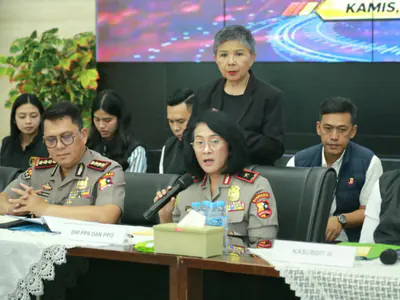
According to TVRI News, the news service of Indonesian public broadcaster TVRI, Brigadier General Nurul Azizah, director of the Directorate of Women and Children Protection and Human Trafficking Crime at the Criminal Investigation Agency (Bareskrim) of Polri, said the 84 victims were returned home during the period. She said police also coordinated with the Witness and Victim Protection Agency, social services agencies, the Women Empowerment and Child Protection Agency, and BP2MI, the Indonesian Migrant Workers Protection Agency, or the Ministry of Migrant Workers (Kementerian P2MI) for assistance.
Nurul said police were still working with the Indonesian National Police's International Relations Division and the International Criminal Police Organization (Interpol) to locate Almisri after an Interpol Red Notice was issued. Police received 207 trafficking reports during the week and rescued 510 victims, including 448 adults and 62 children.
Police detained 238 suspects through intensified routine activities (Kegiatan Rutin yang Ditingkatkan) across regions. The most common method was non-procedural placement of Indonesian migrant workers, accounting for 42 percent of cases, followed by sexual exploitation of adults at 38 percent.
Legal framework and trafficking patterns
Human trafficking usually operates through networks rather than lone perpetrators. Victims are recruited with promises of jobs, schooling, marriage or high wages, then moved, housed and exploited. In practice, trafficking often overlaps with fake job offers, mail-order marriages and online exploitation. In Indonesia, Law No. 21 of 2007 provides the main legal framework for combating trafficking, covering forced labor, slavery, sexual exploitation and organ trafficking. Victims may also be forced to work in mines, factories, ships or entertainment venues without protection.
Irregular migrant-worker placement often occurs because official channels are seen as slow, costly or difficult to access. Prospective workers are persuaded by unlicensed agents, lent money for departure costs and then trapped by debt after arriving abroad. Passports may be withheld, working hours extended and victims employed in sectors outside their contracts. Similar conditions occur domestically, especially among domestic workers, children and victims of sexual exploitation. In some cases, victims are recruited through social media and messaging apps, making networks move quickly.
Victim assistance requires coordination across agencies. Police investigators trace networks and act against suspects, while witness and victim protection bodies, social services and women and child protection units handle shelter, rehabilitation and reintegration. For victims abroad, diplomatic coordination and international police cooperation are part of locating, repatriating and proving cases. Destination countries are often also where evidence must be gathered, so cross-border legal cooperation affects the speed of handling. The framework also touches the restoration of children's rights, such as access to education and health services.
The number of victims rescued in one week should be read as the result of operations, not a complete picture of all trafficking. Many cases are not reported because victims are afraid, their work status is informal or networks move across regions. Therefore, monitoring after repatriation is as important as initial enforcement. Without support, victims risk being recruited again by the same networks. Weekly data can signal operational capacity, but does not automatically show prevention success.
What job seekers should watch for
This story is relevant to Indonesian families and job seekers because many trafficking victims leave home hoping to improve their income. Prospective migrant workers should ensure the placement company is licensed, the employment contract is clear and the route goes through state-recognized institutions. Offers of high pay without documents, passport confiscation or costs that must be financed through debt are warning signs. Checking an agent's legality, contract number and destination can help prevent people from becoming victims.
For communities in regions, trafficking prevention can reduce illegal recruitment practices that harm residents and make law enforcement more difficult. If operations and prevention education are expanded, the public should know that reporting is not only for direct victims but also for witnesses who see suspicious recruitment. The impact is most visible in safe work, child protection and access to social services after victims return. Parents also need to be alert if teenage children work far away or underage.
Economic relevance also appears in the cost of repatriation and rehabilitation borne by the state. The more victims rescued, the greater the need for shelters, psychological support and social reintegration. Readers can monitor whether these services are available in victims' home regions, not only in central institutions. This information matters so victims do not become vulnerable again after returning to their hometowns. Monitoring local services is a measure of whether recovery truly reaches families. Families can ask about referral mechanisms to local social services.
Related coverage
Related stories include Alleged wiretapping of the president: four Indonesian National Police officers become suspects, Legal experts back police investigation of alleged treason in wiretapping case and Traffic Police Corps of the Indonesian National Police holds Operation Zebra ahead of the 2026 Nataru, the Christmas and New Year holiday season.