Indonesian Police Raid Three Prisons, Detain 83 Inmates in Drug Operation
Indonesian police and the National Narcotics Agency (BNN) raided three prisons, detaining 83 inmates on suspicion of drug involvement, with 53 testing positive in urine tests.
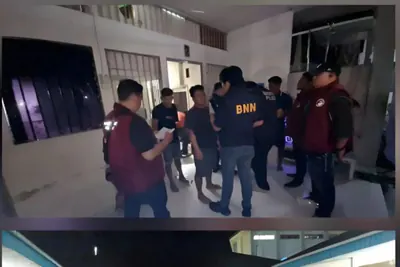
According to TVRI News, the state broadcaster's news service, the Criminal Investigation Agency of the Indonesian National Police (Bareskrim Polri), together with the National Narcotics Agency (BNN) and the Directorate General of Corrections (Ditjen Pemasyarakatan, or Ditjen Pas), raided three prisons in North Kalimantan, West Kalimantan and Bali on 30 October 2026. In the operation, 83 inmates were detained for questioning over suspected drug abuse and trafficking.
Brigadier General (Brigjen Pol.) Kristian Parluhutan Siagian, director of narcotics crimes at Bareskrim Polri, described the raids as part of a simultaneous Operation Sarang Narkoba, or Narcotics Nest Operation. He said the operation followed a directive from National Police Chief (Kapolri) Gen. Suyudi Ario Seto. He added that investigators had shifted their focus to prisons after authorities moved against so-called drug villages.
The prisons searched were Class IIA Tarakan, Class IIA Kerobokan and Class IIA Pontianak. Joint officers found ecstasy, methamphetamine, smoking devices and dozens of mobile phones.
Police Commissioner (Kombes Pol.) Zulkarnaen Harahap, head of Sub-Directorate III of the narcotics crime directorate at Bareskrim Polri, said all the inmates underwent urine tests. Of the 83, 53 tested positive: two of six at Tarakan, 27 of 41 at Pontianak and 24 of 36 at Kerobokan.
Inmates who tested positive were taken to the narcotics directorate of the relevant provincial police command for further questioning. Those who tested negative and were not found with communication devices were returned to their prison blocks. Investigators are also tracing the seized phones to uncover alleged drug networks operating from inside prisons.
Drugs Behind Bars and What the Terminology Means
Prisons are meant to rehabilitate inmates, but in practice they can become vulnerable points for illicit drug trade. Overcrowded detention spaces, limited supervision and gaps in contact with visitors, staff and outsiders can allow prohibited items to enter through many channels. Operations inside prisons therefore usually target two things at once: hidden evidence and people suspected of controlling transactions from within.
The language used in such operations needs careful reading. A narapidana is a convicted inmate serving a sentence, while a person questioned may still only be a witness. Urine tests are an initial screening tool that may indicate drug use, but a positive result does not automatically prove someone is a trafficker or network controller. To move a person to suspect status, investigators need sufficient evidence under criminal procedure law.
Mobile phones are important items in prison searches. In some cases, communication devices are used to contact couriers, arrange payments or monitor prices from behind bars. The seizure of dozens of phones is therefore not just a physical find; it opens the way to tracing numbers, messages and contact patterns. Investigators usually examine whether the phones were used by the detained inmates or by other people who had left them with inmates.
The cooperation between Bareskrim Polri, BNN and Ditjen Pemasyarakatan shows that drug enforcement in prisons cannot be handled by one agency alone. The police handle investigation, BNN is involved in prevention and eradication, and corrections authorities control prison blocks, residents and security procedures. Each role is important to ensure the operation does not only produce inspection numbers, but also closes supervision gaps and strengthens integrity among prison staff.
What the Public Should Watch For
For readers, prison raids are not merely distant crime news. Prisons are part of a legal system that touches many families. When drug activity is alleged to be controlled from inside, the public has a right to ask whether visit controls, item checks and block security are adequate. The discovery of phones and smoking devices shows those gaps are real, making stronger procedures a necessity.
The impact on the wider community can be felt in two ways. First, if networks inside prisons are disrupted, potential drug circulation outside may fall, although the effect is not immediate. Second, such operations can help restore public confidence that the state is enforcing the law, not only detaining people. However, without transparent investigation results, the public should still avoid judging all the inmates detained.
For families of inmates, the lesson is to follow visiting rules and not entrust unauthorized items. For drug users, the positive urine tests in prisons are a reminder that abuse can occur even in places that should be most controlled. Going forward, the key questions are whether these inspections lead to clear legal proceedings and whether prison supervision improves.